Licensed & Insured • Serving Philly & the Tri-State

Foundation Repair in Philly
✓ 1,500+ five-star reviews • ✓ 22+ years in Philly • ✓ Licensed & insured

Foundation Repair in Philly
✓ 1,500+ five-star reviews • ✓ 22+ years in Philly • ✓ Licensed & insured
If you’ve noticed a crack creeping across your basement wall, a door that suddenly sticks, or a floor that doesn’t feel quite level anymore, you’re not alone — and you don’t need to panic. In a city full of century-old row homes, twin homes, and masonry foundations, some settling and cracking is simply part of a house’s history. The real question isn’t whether a crack exists. It’s what’s causing it, whether it’s still moving, and whether it needs a repair now or just a bit of monitoring.
At Basement Gurus, we’ve spent over 22 years inspecting and repairing foundations across Philly— from South Philly rowhomes to Northeast Philly twins to older Germantown stone foundations. Our approach to foundation repair in Philly starts with an honest, in-person inspection, not a sales pitch. We’ll tell you plainly what we see, what it likely means, and what — if anything — needs to be done about it.
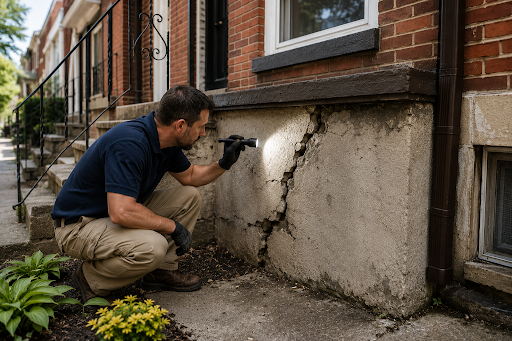
Signs You May Need Foundation Repair
Most homeowners don’t call us because they’ve read about foundation repair — they call because something in the house changed. These are the symptoms we hear about most often from Philly homeowners:
- Cracks in basement walls, especially ones that seem to be growing
- Stair-step cracks running through masonry or block walls
- Horizontal cracks, or cracks that appear to be widening
- Bowing or leaning basement walls
- Uneven, sloping, or sagging floors
- Doors and windows that suddenly stick or won't latch properly
- Visible gaps forming around door and window frames
- Water entering the basement through foundation cracks
- Any sign of movement between a wall and the floor or ceiling
Seeing one of these signs doesn’t automatically mean your foundation is failing. Some cracks are cosmetic and stable; others point to settlement or structural movement. An inspection is what tells the difference — not guesswork.
What Type of Foundation Problem Do You Have?
Not every crack tells the same story. The direction, width, movement, and any accompanying water intrusion all factor into what a crack actually means. Here’s a general guide — though we’d always recommend an in-person look before drawing conclusions from a photo or a general chart:
| Problem | What It May Indicate |
|---|---|
| Vertical cracks | Often settlement, concrete shrinkage, or minor movement, depending on width and location |
| Horizontal cracks | Potential lateral soil pressure or wall movement — generally worth a closer look |
| Stair-step cracks | Masonry movement or settlement, especially common in block foundations |
| Bowing walls | Lateral pressure from soil or hydrostatic pressure pushing against the foundation |
| Uneven floors | Settlement or foundation movement affecting the structure above |
| Water through cracks | A foundation leakage or moisture issue, which may or may not involve structural movement |
The bottom line: a crack is one data point, not a diagnosis. We look at the whole picture — location, size, pattern, and what’s happening around it — before recommending anything.
Types of Foundation Repair We Provide
Once we understand what’s actually happening with your foundation, we recommend the repair that matches the problem — not a one-size-fits-all fix. Here’s what that can look like.
Foundation Crack Repair
Not every crack needs the same treatment. Whether a crack is purely cosmetic, structural, or letting water into the basement changes the right approach — from a simple sealant to injection methods to reinforcement. We evaluate the crack itself along with the surrounding wall before recommending a fix.
Structural Foundation Repair
When a foundation shows signs of real movement — not just a stable hairline crack — the goal is stabilization, not just patching what’s visible. Depending on what we find, that can include wall stabilization, foundation reinforcement, underpinning, structural crack repair, or settlement correction. We don’t label every crack “structural” — we reserve that term for cases where the inspection actually supports it.
Concrete Foundation Repair
Concrete foundations develop their own set of issues over time: cracked walls, surface deterioration, spalling, settlement-related cracking, slab problems, and water-related concrete breakdown. Concrete foundation repair in Philly often means addressing both the visible damage and the underlying moisture or settlement issue causing it, so the repair actually holds.
Basement Foundation Repair
Foundation issues and basement moisture are often connected. A crack that lets in groundwater is both a structural and a water-management problem. That’s part of why our foundation work often pairs naturally with drainage improvements and waterproofing — treating the structure and the water source together, rather than as two separate jobs.
Foundation Problems in Older Philly Row Homes
Philadelphia’s housing stock is different from a lot of the country’s, and that matters for foundation work. Many of our row homes, twins, and older single-family homes were built with masonry foundations, shared or party walls, and aging mortar that’s decades — sometimes over a century — old. Additions and renovations sometimes place new loads on foundations that were never engineered for them, and shallow, older foundations can respond differently to soil movement and water than a newer, code-built home.
That doesn’t mean every older Philly home has a foundation problem — plenty of century-old rowhomes are perfectly stable. It does mean that when something in this kind of home does move, we bring local, hands-on experience with masonry construction, shared walls, and older basements to figuring out why.
Cause vs. Symptom: Why We Don’t Just Fill the Crack
A foundation crack is a symptom — not necessarily the root cause. Filling a crack without understanding why it formed is a bit like painting over a water stain: it may look better for a while, but the underlying issue is still there. Contributing factors we look for include:
- Soil movement or expansive soil
- Settlement of the foundation or footing
- Hydrostatic or lateral water pressure
- Poor drainage or grading around the home
- Aging or deteriorating masonry and mortar
- Structural loads, including additions or renovations
Our goal with any foundation repair in Philly is to address what’s actually driving the problem, so you’re not looking at the same crack again in a few years.
How Our Foundation Inspection Works
We’d rather explain what we do than just ask you to “contact us for foundation repair.” Here’s what a typical inspection looks like:
- Visual inspection We examine foundation walls, floors, cracks, masonry, and the surrounding areas inside and outside the home.
- Identify symptoms We look for signs of settlement, lateral movement, moisture intrusion, and drainage issues.
- Determine the likely cause Any recommended repair should address the underlying issue — not just cover up the visible crack.
- Recommend an appropriate solution Not every foundation needs the same repair. We match the solution to what the inspection actually shows.
- Walk through the plan with you We explain the scope of work, what to expect, and any relevant warranty details — in plain language, before any work begins.
When Should You Have Your Foundation Inspected?
Plenty of foundation cracks are minor and stable, and simply monitoring them is a reasonable approach. Others deserve a professional look sooner rather than later. Consider scheduling an inspection if you notice:
A crack that’s visibly getting wider
New cracks appearing where there weren’t any before
Horizontal cracking
Bowing or leaning basement walls
Noticeable floor slope
Doors or windows that have become hard to open or close
Water coming through foundation walls
Visible separation between a wall and the floor or ceiling
Any symptom that seems to be getting worse over time
Some foundation cracks are cosmetic, while others may indicate settlement or structural movement. An inspection can help determine the cause and the appropriate repair — that’s really the only way to know for sure.
Choosing Among Foundation Repair Companies in Philly
There’s no shortage of foundation companies in Philly, and it’s worth being a little selective — this is your home’s structure, after all. Before you hire, it’s worth checking a few important details:
- Do they offer a real, in-person inspection before quoting a price?
- Are they licensed and insured to work in Pennsylvania?
- Do they explain why a repair is needed, not just what it costs?
- Can they show real project examples or references from Philly homes?
- Is the warranty written down, and does it transfer if you sell the home?
When you’re comparing structural foundation repair in Philly companies, a contractor who’s willing to walk you through the diagnosis — not just the price — is usually a good sign.
Philly Areas We Serve
We provide foundation repair throughout Philly and the surrounding counties, including South Philadelphia, West Philadelphia, Northeast Philadelphia, Northwest Philadelphia, Fishtown, Kensington, Germantown, University City, and Center City, along with the greater PA and New Castle County, DE area. Every neighborhood has its own mix of housing stock and soil conditions, and we bring that local context into every inspection.
Why Homeowners Choose Basement Gurus
We’re a family-owned company, not a franchise — Basement Gurus has been keeping Philly homes dry and stable for over 22 years, and the people who show up to inspect your foundation are the same people who stand behind the work.
- Proudly licensed and insured, with service across Philly and neighboring counties.
- 22+ years of hands-on foundation and waterproofing experience in the Philly area
- 1,500+ five-star customer reviews, BBB A+ rating, and a HomeAdvisor/Angi Super Service Award
- Free, no-pressure inspections and clear, written estimates
- Lifetime, transferable warranty on our foundation and waterproofing work
- Straight answers — we explain what we see and only recommend what your home actually needs
Philly Foundation Repair Project
- Problem
- A homeowner in Northeast Philly noticed a cracked, bowing basement wall and reached out for an inspection before the issue got worse.
- Inspection
- Our team evaluated the wall’s crack pattern, the degree of bowing, drainage conditions around the home, and signs of lateral soil pressure.
- Solution
- We stabilized the bowing wall and sealed the active cracks, addressing the lateral pressure that was driving the movement rather than just patching the surface.
- Result
- The wall was stabilized and the cracks sealed, with the work backed by our transferable lifetime warranty — giving the homeowner a repair that’s built to last, not just look fixed.
Foundation Repair FAQs
It depends on the cause and extent of the problem, which is exactly why we start with a free, in-person inspection rather than a phone estimate. Once we know what’s actually going on, we’ll give you a clear, itemized quote before any work begins.
Look at whether it’s widening, whether it’s horizontal, whether it’s accompanied by bowing or water intrusion, and whether nearby symptoms — like sticking doors or sloping floors — are present. When in doubt, an inspection is the most reliable way to know.
Common contributors include soil movement, poor drainage or grading, hydrostatic water pressure, aging masonry and mortar, and additional structural loads from renovations — often in combination rather than any single cause.
Some settling and cracking is common in homes with decades of age and masonry construction. That doesn’t mean every crack is serious — it means older homes benefit from an inspection that accounts for their age and construction rather than a generic checklist.
Timelines vary with the scope of work, but many residential foundation repairs are completed in a matter of days. We’ll provide a clear timeline after assessing the job.
It can address water that’s entering through a foundation crack, but ongoing basement moisture often also involves drainage or grading. We’re happy to evaluate both during your inspection.
Underpinning is typically considered when a foundation has settled significantly or needs additional support — it’s not a routine fix for minor cracking. We’d only recommend it if the inspection clearly supports it.
Many sellers choose to address known foundation issues before listing, since buyers and inspectors will likely flag them anyway. An inspection can help you understand the scope before you decide.
Shared walls, masonry construction, and older mortar can all affect the right repair approach, so yes — rowhome foundation work often looks a little different than a detached suburban home.
Not always. For clearly cosmetic or minor issues, it usually isn’t necessary. For more significant structural movement, we may recommend involving a structural engineer as part of the plan.
Request a Foundation Inspection
If you’re seeing cracks, bowing walls, or a floor that isn’t quite level, the next step is simple: a free, honest inspection. We’ll walk your basement with you, explain what we find in plain language, and let you know whether it’s something to monitor or something to fix — no scare tactics, no pressure.
Call Basement Gurus at 800-834-6584 or email gurusbasement@gmail.com to schedule your free foundation inspection. Family-owned, licensed & insured, and proud to serve Philly and the surrounding counties.